A torque wrench helps you apply a specified turning force to a fastener, but the useful number comes from the assembly’s instructions. You cannot choose the correct setting just by looking at the bolt or deciding how tight it feels.
Think of the wrench as one part of a documented procedure that also identifies the fastener, thread condition, sequence, and any additional steps. If those details are missing, your first job is to find them rather than guess a value.
Find the specification for the exact assembly
Use the current service or installation information for the exact product and connection you are working on. A nearby bolt on the same object may have a different role, material, or required tightening procedure.
Write down the specification with its units and any conditions in the same note. A loose number on a piece of tape is easy to misread after you have moved between a bicycle component, a shop fixture, and a household assembly.
Check whether the procedure calls for a particular fastener replacement, lubricant, thread treatment, staged sequence, or angle after tightening. Do not silently substitute your own preparation and assume the published value still means the same thing.
If the connection affects braking, steering, suspension, structural support, pressure containment, or another consequential function, follow the applicable qualified-service requirements. A beginner’s torque-wrench guide cannot establish whether your assembly is serviceable.
Read the unit before touching the adjustment
Inch-pounds, foot-pounds, and newton-meters are different units. Some wrenches display more than one scale, so identify the scale you will use and read its corresponding markings from the start.
Keep any necessary conversion in a written calculation and check it independently with a reliable conversion reference. Better still, use the specified unit directly when your correctly ranged tool supports it.
Do not copy a displayed number between tools unless you have confirmed both unit labels. The size of the handle or square drive is not evidence of the unit used on its scale.
Take a clear photo of your intended setting if the scale is hard to see in the working position. Review it before approaching the assembly, and keep the actual unit visible rather than cropping the photo down to the digits.
Choose the right wrench for the required range
Confirm that the target falls within the manufacturer’s measuring range and permitted direction for your exact wrench. A ratchet may turn both ways even when a particular wrench does not measure both directions.
Read the model-specific manual rather than applying a rule from a different wrench in the same brand. TEKTON publishes separate instructions for its older click models, current micrometer models, and electronic tools, which is a useful reminder that details change.
Leave tools with unreadable scales, missing identification, or uncertain condition out of the job until their suitability is established. A smooth-looking handle does not tell you whether a measuring instrument is accurate.
Do a bench planning check before you buy a wrench for one connection. The tool must fit the required range and also give you enough room to load the handle as its instructions require.

Set it where you can read it clearly
For an adjustable click wrench, follow its unlock, adjust, and lock sequence exactly. The main scale and rotating scale may combine to give the final setting, so do not assume the nearest large marking is the whole reading.
Keep the manual beside you during your first few setups and compare its worked example with the markings in your hand. A quiet, well-lit bench is a better place to learn the scale than a cramped final installation.
After locking the setting, read it again without relying on what you intended to set. This second look catches an easy mistake: doing the arithmetic correctly and then stopping at the wrong mark.
For an electronic wrench, confirm the selected mode, units, target, and alert behavior using that model’s instructions. An illuminated screen does not remove the need to understand what the tool is actually measuring.
Apply force where the maker intends
Position the proper socket fully on the fastener and load the designated handle area. TEKTON’s model 24320 manual specifies the knurled handle and a smooth pull, with particular care at low settings where the click can be subtle.
For that click wrench, release pressure as soon as the indicated click occurs. Repeated clicking or continuing the pull after the signal is not a way to improve the result.
Other wrench types communicate differently, so learn your tool’s signal before using it on an important connection. Do not borrow the click-wrench routine for an indicating or electronic model without checking its operating procedure.
Keep the setup aligned and avoid a position that forces you to jerk the handle or lean into the pull. If the working space prevents the intended technique, find an approved access method or seek appropriate help.
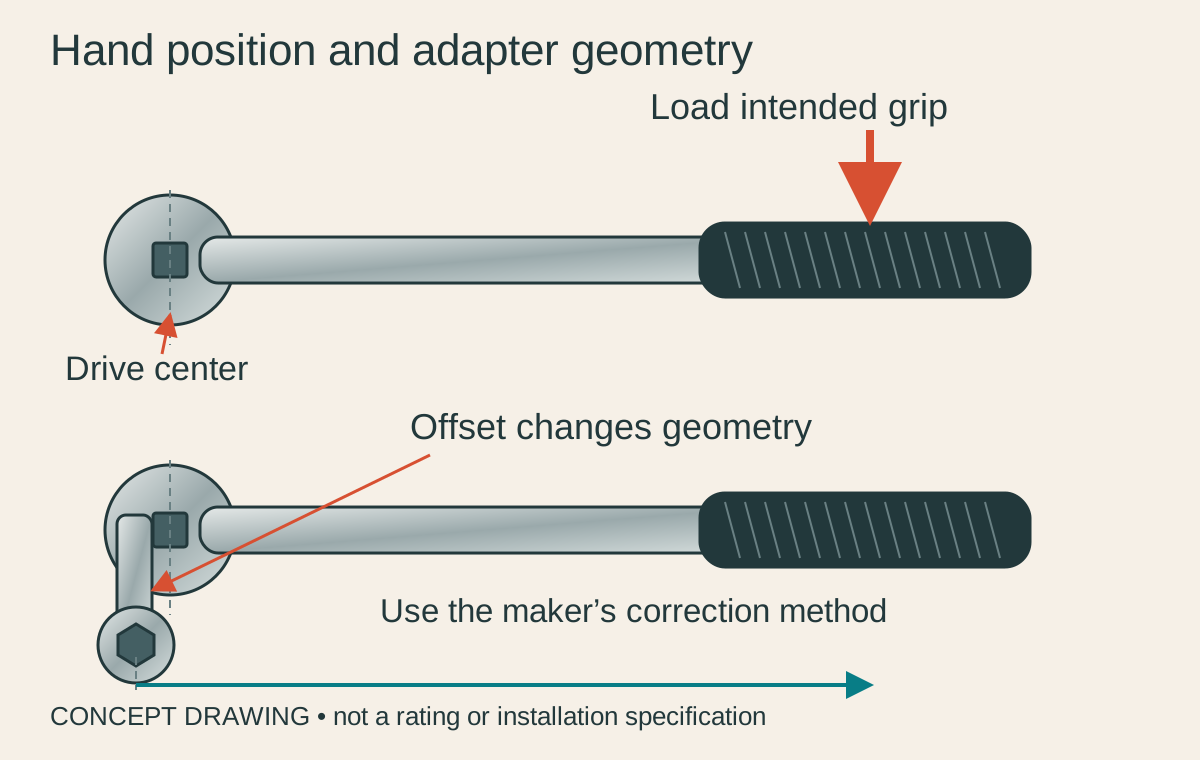
Treat adapters as a measurement question
A crowfoot or another off-axis attachment can move the fastener away from the wrench’s square-drive center. TEKTON’s current micrometer manual explains that a changed effective length can require a corrected setting.
Do not assume that pointing an attachment in roughly the right direction makes every combination valid. Use the exact instructions for the wrench and accessory, including how any required dimensions are defined.
Keep the assembled tool on the bench while you plan the access and correction. If you cannot clearly identify the relevant centers or orientation, the uncertainty needs resolving before you use the setup.
For straightforward learning, choose an uncomplicated approved socket arrangement. Saving an awkward adapter combination for a better-equipped or more experienced operator is a sensible task choice, not a failure to use the wrench.
Store the specific wrench you own
Follow the exact model’s storage instruction, which may differ between mechanisms. For example, TEKTON’s 24320 manual calls for its lowest marked setting and specifically says not to adjust below that setting.
That instruction is an example, not a universal command to turn every torque wrench to zero. Keep the model manual or storage note with the case so you do not substitute a remembered rule.
Wipe and protect the tool according to its instructions, and store it in its intended case in a suitable environment. Do not leave it loose beneath heavy sockets or treat the scale as an ordinary workshop handle.
Put the wrench away as soon as the measured work is complete. Keeping it separate from your loosening tools makes it less likely that you will grab it later to break a stuck fastener free.
Know when confidence needs a check
If the tool has been dropped, overloaded, damaged, or gives an unexpected signal, stop and ask the manufacturer or a qualified service provider about inspection and calibration. A homemade comparison against another unknown wrench does not establish accuracy.
Follow any calibration interval required by the manufacturer and the work you perform. Use an appropriate service that can test the instrument and document the result, rather than trying to repair its internal mechanism from an online shortcut.
TEKTON’s recertification service, for example, distinguishes testing within tolerance from adjustment followed by retesting. That distinction helps you ask a useful question: was the instrument actually measured, and what does the resulting record cover?
Keep that record with the tool identification and your job notes when the application calls for traceability. Good torque work starts with a valid specification and ends with a clear procedure, a suitable instrument, and a result you can explain.
Before you return an assembly to use, check the complete service procedure for any inspection or verification steps beyond tightening. Record the connection you completed and avoid describing other untouched fasteners as checked merely because they sit nearby.
If you were interrupted mid-sequence, use a written progress note to decide where to resume according to that procedure. Memory is a poor place to store a partly completed job.