Choose a bench that fits both work and storage
A folding workbench has to solve two space problems: where you can use it and where you can put it afterward. The best choice for a tight workshop gives you a stable, appropriate working arrangement without blocking the room every time you unfold it.
This shortlist compares the WORX WX051 Pegasus, Keter folding work table in the inspected Amazon package, and BLACK+DECKER WM225-A Workmate. Their useful differences are the worktop and clamping arrangements, rather than a pretend hands-on ranking of stiffness or folding speed.
Choose the Pegasus if its broad top and included clamp arrangement suit your tasks, examine the Keter for its table-style layout, or consider the Workmate for adjustable jaws and pegs. Check the complete operating footprint and manual before treating any of them as the answer to a cramped room.

Measure the room with the bench open
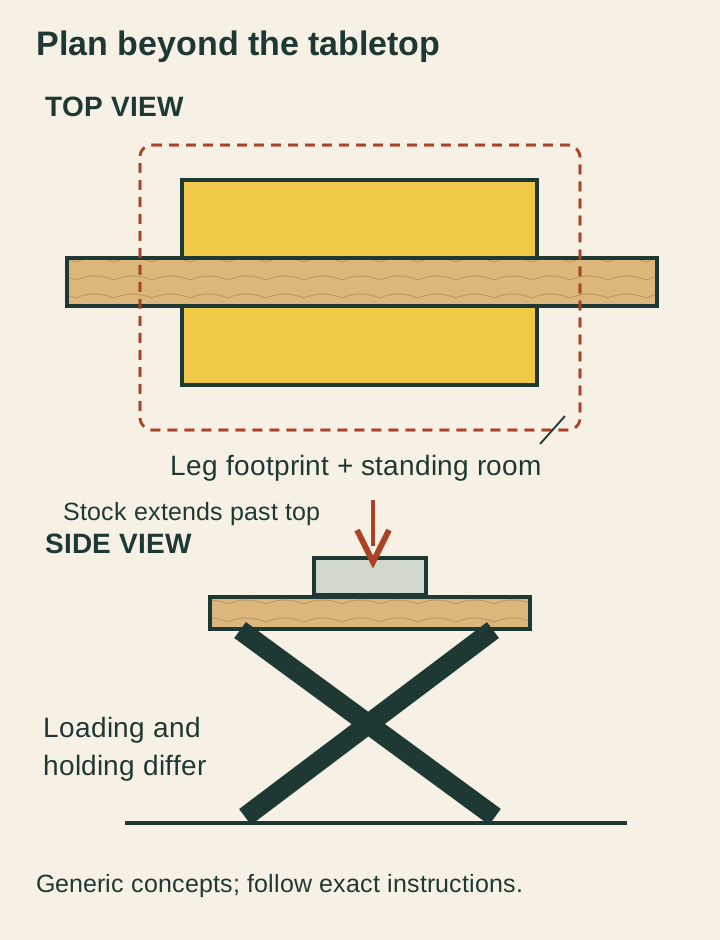
Mark the proposed bench position on the floor, then include the actual material around it. A long board, a door, or a hose can need more room than the folded bench suggests, especially when you have to walk around the work or support its far end.
Keep access to doors, controls, and your exit route in the plan. You also need a suitable floor and a place to stand without tripping over legs, cords, storage boxes, or the offcut from the operation you’re about to perform.
Measure the storage path as well as the storage space. A bench that fits behind a cabinet may still be awkward if carrying it there requires threading a bulky folded frame through a narrow passage or lifting more than you can comfortably manage.
| Exact selection | Useful distinction | Check before buying |
|---|---|---|
| WORX WX051 Pegasus | US WX051 table/sawhorse, two quick clamps and four dogs | Match your work, current selected package and exact instructions; no hands-on performance claim. |
| Keter folding work table | Selected one-table Amazon package with two 12-inch clamps; no specs transferred from newer 273336 | Match your work, current selected package and exact instructions; no hands-on performance claim. |
| BLACK+DECKER WM225-A Workmate | WM225-A project center with four swivel pegs | Match your work, current selected package and exact instructions; no hands-on performance claim. |
WORX WX051 Pegasus: a table and sawhorse configuration

The inspected WX051 Pegasus package includes two quick clamps and four clamp dogs. The documented worktop is approximately 31 by 25 inches, giving you a useful reference for comparing its table-style surface with the narrower jaw arrangement on the Workmate.
Consider it when your tasks benefit from a broad top and the supplied workholding layout. Check how your actual part sits on the surface and where the clamps contact it, rather than assuming an included clamp automatically secures every shape.
The listing distinguishes a 300-pound table capacity from a 1,000-pound sawhorse capacity. Those figures describe different configurations and aren’t interchangeable permission to place the higher load on the tabletop or to add dynamic cutting forces without considering the instructions.
We haven’t measured wobble, top deflection, or how the clamps behave under a particular cut. If those are decisive requirements, inspect a display model and review the exact manual’s workholding and loading limits before purchasing.
Keter folding work table: check the exact package

The inspected Keter listing presents a folding table with two 12-inch clamps and a resin-and-aluminum construction arrangement. Consider it when you want a table format and the listed clamp system matches the shapes you plan to hold.
Check the current Amazon package carefully because Keter has sold multiple folding tables and model revisions. A current manufacturer page for a different product number is not enough reason to assign that newer model’s dimensions, parts, or features to the older listing.
The listing advertises a 1,000-pound capacity, but that figure isn’t a comparison test of how the bench behaves during your operation. Workpiece support, loading arrangement, floor, setup, and the instructions for the exact product still matter.
Make sure you can obtain the matching assembly and use instructions and identify replacement clamps or other required parts. If the package or product identification is unclear, resolve it with the seller or manufacturer before making an apparently convenient table part of your workshop plan.
BLACK+DECKER WM225-A: jaws and pegs instead of a broad top

The WM225-A Workmate uses adjustable jaws and four swivel pegs, with legs that fold under for a lower configuration. Its appeal is that workholding arrangement, which can be useful when the shape of the part matters more than having a large uninterrupted tabletop.
Consider it when you want to position a part between jaws or use the pegs for a suitable irregular shape. You still need to check the clamping range, contact points, and setup instructions for the actual piece rather than treating the vise description as universal compatibility.
The manufacturer’s current page contains conflicting dimensions, weights, and a force-related typo, so we haven’t used those figures to rank it. Confirm the exact manual and package measurements when storage height, carrying weight, or load limits decide whether it will work for you.
A narrow workholding platform also changes where loose tools and accessories can sit. Plan a separate stable location for items you need nearby instead of balancing them on a part, a gap between jaws, or an exposed edge.
Distinguish support capacity from workholding
A published load capacity tells you something about a specified support configuration, but it doesn’t describe every force generated by a tool. Pushing sideways on a tall piece or feeding a long board can introduce movement that a simple vertical weight figure doesn’t address.
The work also needs to be secured against the movements the operation can create. Holding a board to a top is a different question from keeping the entire bench stable, and both need to be resolved before you switch on the tool.
For long material, plan suitable additional support without creating a new tipping point or blocking the tool path. Follow the tool and bench instructions instead of using the biggest advertised capacity as a shortcut around that planning.
Check the fold and setup sequence without rushing
Read the opening, locking, and closing sequence before assembling a newly delivered bench. Confirm each required lock or brace is in its operating position and keep fingers clear of the moving joints identified in the instructions.
An apparently open frame isn’t necessarily a fully secured working configuration. If a lock doesn’t engage, a part appears bent, or the bench doesn’t sit as intended, stop and resolve the condition rather than relying on the workpiece weight to hold it together.
When you’re done, remove tools and loose parts before folding. Store the bench in the approved position so it cannot fall into a walkway or pull down other items when you retrieve it for the next job.
Compare the package you will really use
Include the clamps, dogs, accessories, and any extra supports your first project needs when comparing cost. A slightly cheaper bench can be less useful if its available clamping arrangement doesn’t reach the contact points you already measured.
Also consider whether the work surface suits your intended operations and cleanup. Painting, drilling, assembly, and cutting ask different things of a top, so don’t assume a plastic table or jaw board is a sacrificial surface unless the instructions support that use.
If the bench will move between home and another location, check the carrying arrangement and folded dimensions from the exact model’s documentation. Convenience claims on a shopping page don’t establish whether you can safely manage the load yourself.
Make the final choice with one real project
Write down the part dimensions, holding points, tool approach, floor space, and storage location for your next job. Compare each bench against that list, and eliminate configurations that don’t meet it before worrying about extra features.
The Pegasus offers the inspected table-and-clamp package, the Keter offers a different folding-table format, and the Workmate offers adjustable jaws and pegs. Those differences give you practical choices without claiming a measured winner that our research can’t establish.
Whichever you choose, practice the setup with the bench empty before adding a project. A familiar unfolding sequence and a clear working area are part of making a folding bench useful every time, rather than just easy to store.
Leave a place to put the accessories
Find a dedicated home for the removable clamps and dogs while the bench is folded. Keeping those pieces with the matching instructions makes the next setup simpler and helps you notice a missing component before the project starts.
Check the stored frame and accessories before unfolding after a long break. Storage in a crowded garage can introduce damage or missing parts even when the previous project ended without an obvious problem.