Choose the fasteners before the feature count
A multi-bit screwdriver earns its place when you can reach for one handle and find the tip your small repair actually needs. A longer list on the package helps only if it includes the drive types and sizes already scattered around your home.
For a small home kit, start with a quick inventory: the screws on a furniture project, a loose knob, and the ordinary brackets you maintain. Then decide whether you want a simple reversible driver, broader tip coverage, or a ratchet for repeated turns.
These three options are research-based selections from manufacturer specifications and exact Amazon listings, not the results of a hands-on test. There are no durability scores or measured comfort rankings here, and the best fit depends on the fasteners and access you actually have.
The shortlist at a glance
Choose the STANLEY 68-012 if your list mostly calls for common Phillips and slotted tips plus small nut-driver functions. Choose the Klein 32500 when square and Torx coverage matters as well, without adding a ratcheting mechanism.
Choose the Klein 32305 when you specifically want forward, fixed, and reverse ratchet settings with a wider documented tip selection. You don’t need to buy all three; use the comparison to identify a gap in your kit before adding another handle.
| Model | Choose it for | Check the limit |
|---|---|---|
| STANLEY 68-012 | Phillips/slotted basics and two nut-driver functions | No listed square or Torx tips |
| Klein 32500 | Square/Torx coverage and three nut-driver sizes | Fixed driver; nonmagnetic; not insulated |
| Klein 32305 | Ratcheting action and wider listed tip selection | One listed nut-driver size; not insulated |
STANLEY 68-012: a straightforward starting point

The STANLEY Quick Change 6-Way is the simplest configuration in this shortlist. Its documented functions cover Phillips #1 and #2, slotted 3/16-inch and 1/4-inch, and 1/4-inch and 5/16-inch nut drivers, which gives you a clear checklist to compare with ordinary household hardware.
That modest selection is the reason to consider it, rather than a weakness you must overcome by buying more accessories. If your small-project list fits those sizes, you can keep the decision focused on one tool and learn how its reversible components fit together.
The compromise is easy to identify: the listed package doesn’t give you Torx or square tips. If a furniture instruction sheet specifies a hex key, neither this feature count nor a Phillips bit is a substitute for the actual required tool.
STANLEY documents a chrome-plated bar, but that doesn’t establish a measured corrosion lifetime or a comfort result for your hands. The Amazon page showed buying options rather than a featured offer when checked, so confirm the seller, package, delivery, and return terms before ordering.
Klein 32500: broader coverage without a ratchet

The Klein 32500 combines eight screwdriver tips with three nut-driver functions. The manufacturer lists Phillips #1 and #2, two slotted sizes, square #1 and #2, Torx T10 and T15, and nut drivers in 1/4-inch, 5/16-inch, and 3/8-inch sizes.
That makes it the more relevant starting point if your inventory includes square-drive fasteners or those two Torx sizes. It also gives you another nut-driver size compared with the STANLEY, without asking you to choose a ratchet direction before turning the handle.
Check the model number carefully, because 32500, 32500MAG, and 32500HD are separate products. Klein lists this plain 32500 as nonmagnetic and not insulated, so don’t transfer the magnetic or impact-related features of a similarly named version onto this one.
Replacement inserts are documented, which gives you a practical route to investigate if a bit goes missing. It doesn’t mean every loose quarter-inch bit fits the reversible assembly, so match replacements to the exact catalog number rather than buying on appearance.
Klein 32305: choose it for the ratchet

The 32305 adds a collar with forward, fixed, and reverse settings. If your project involves repeated screw turns and you want that mechanism, it offers a different way of working from the two fixed drivers rather than merely a larger number on the handle.
Its documented tip selection includes Phillips #0 through #3, two slotted sizes, square #1 and #2, Torx T10, T15, T20, and T25, and combo #1 and #2. It also has a 1/4-inch nut-driver function and onboard storage for the interchangeable tips.
The selection still has boundaries: it isn’t a metric hex-key set, and its single listed nut-driver size doesn’t replace the three sizes on the 32500. Compare the specific missing function before assuming fifteen functions will cover everything eleven functions did.
Klein lists an overall length of 8.71 inches and identifies the tool as nonmagnetic and not insulated. Use that documented length as an access-planning clue, not a promise that it will reach a recessed screw or turn comfortably in every cabinet corner.
Look at the tip and the space around it
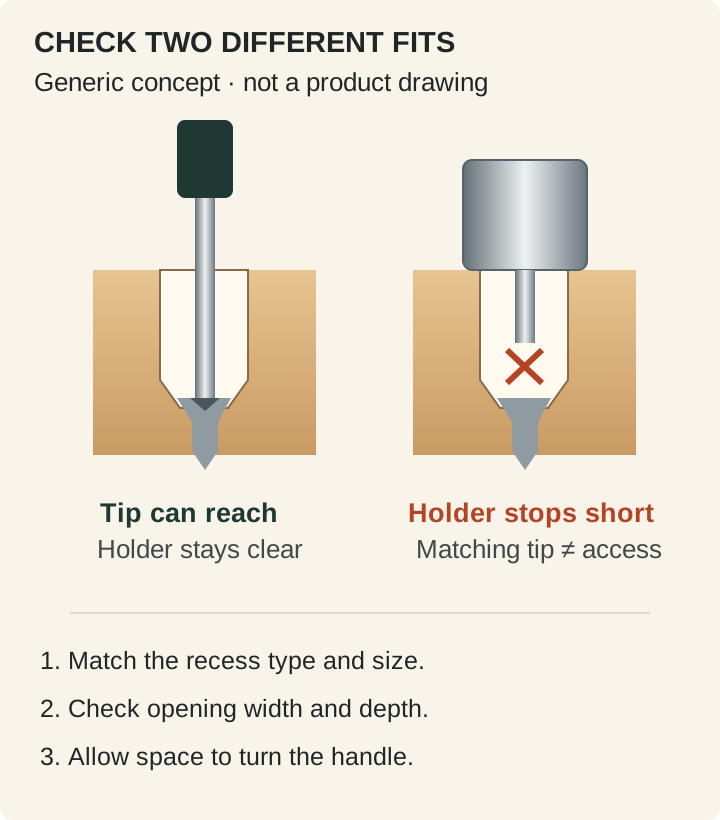
Before you buy, look beyond the visible screw head to the space the holder must enter. A bit may match the recess while the surrounding barrel is too wide for the opening, and the feature count won’t reveal that mismatch.
For a deep opening, measure the usable path and compare it with specific tool dimensions or drawings. If the manufacturer doesn’t document the clearance you need, leave the fit unresolved instead of assuming a longer overall screwdriver automatically has a narrower working end.
Do the same for the handle’s turning space. You may need an offset or a short tool for one awkward location, even if a normal multi-bit driver remains the right choice for the rest of your home kit.
Use the right fit, with controlled pressure
CCOHS advises matching both the type and size of the screwdriver to the screw head. A Phillips-like recess deserves a closer look before you start; using a nearby-looking tip can spoil the head and make the next attempt harder.
Keep the shank in line with the screw, secure a small moving workpiece, and use only the pressure needed to maintain contact. If the tip slips, stop to inspect the fit and condition instead of responding with a tighter grip and another forceful turn.
These are general-purpose fastening choices, not a recommendation for energized electrical work. Plastic or rubber around a handle is not evidence of electrical protection, and both Klein models here are explicitly listed as not insulated.
Keep a small kit useful after purchase
Give the driver a defined place with its matching inserts, and check the storage positions when you finish a job. Finding a missing tip while you’re putting things away is much easier than discovering it when you’re balancing the next project in position.
Keep the handle clean and inspect the working ends for damage. Replace the correct part when necessary, rather than filing an unfamiliar replacement into shape or turning the screwdriver into a pry bar because it’s already in your hand.
If a new job requires a drive size outside the supplied set, add that exact tool deliberately. A modest kit that covers your actual fasteners is more useful than a crowded drawer whose pieces have unknown sizes and no matching instructions.
How these picks were selected
The comparison is limited to three general-purpose, manually operated multi-bit drivers with identifiable model numbers and documented contents. Manufacturer pages establish the listed functions; the Amazon pages were checked for the matching model, current listing, and primary product image.
We haven’t measured torque capacity, ratchet life, grip comfort, or resistance to slipping. The labels describe situations each configuration may suit, so use your own access needs and the maker’s instructions to make the final choice.
Prices, sellers, and package options can change, and no price is promised here. Open the linked listing, confirm the same model and included components, and skip the purchase if the offer or tool doesn’t match what your project requires.
Put three examples from your own tool kit beside your shortlist notes: a fastener you use frequently, one with a different drive type, and one in a recessed position that limits access to the head. Use that small inventory to check the listed tips, working space, and replacement arrangements before choosing, so an appealing count of functions doesn’t distract you from the particular connection you need the driver to reach.