Your cordless tool battery needs instructions for its exact system, not a temperature rule borrowed from a different brand. Start by identifying the pack and charger you own, then turn their guidance into a simple storage and charging arrangement you can follow at home.
This guide focuses on removable power tool batteries and ordinary home workshop planning. It does not provide a repair method for battery packs or an emergency handling procedure for a battery that is heating, smoking, leaking, or otherwise behaving abnormally.
Identify all three parts of the system
Photograph the labels on the tool, battery, and charger while everything is disconnected as its instructions require. Include the full model identifiers and any date or serial information you can read without opening the pack.
Save the official instructions for those identifiers in one folder. A charger that looks similar in a shopping photo may have different compatibility or operating directions, so keep your record tied to the equipment in your hands.
Check the manufacturer’s compatibility information before connecting a pack to a charger or tool. Physical fit by itself is not a reliable way to settle a compatibility question, especially when used equipment has arrived without its paperwork.
Write a short inventory line for each combination you actually use. You might have two tools sharing one approved battery family and a second, older system that needs its own separate charger and instructions.
Keep charging, using, and storing instructions separate
Give your note separate headings for charging temperature, operating temperature, storage conditions, and long-term preparation. Do not move a number from one heading into another just because you would like a single rule for the garage.
Copy the exact units and the relevant model beside any limits you record. If the manual does not answer your storage question, mark it unanswered and contact the maker rather than filling the gap with another tool’s instructions.
Think about the place itself as well as the weather forecast. A cabinet in a garage, a parked vehicle, and a shaded room may experience different conditions even on the same afternoon.
For example, if your garage’s suitability is uncertain, your next task is to verify the actual conditions and compare them with the instructions. Buying a second charger does not answer that storage question.

Use manufacturer examples without turning them into universal rules
DEWALT’s battery safety page recommends cool, dry storage and charging, avoiding liquids and extreme temperatures, and using authentic batteries compatible with its tools and chargers. It also says not to use visibly damaged or cracked batteries or attempt pack repair.
For extended storage longer than six months, that page gives DEWALT-specific preparation guidance, including charging and disengaging the battery from the tool. Check the instructions for your exact equipment before using that advice, especially if your collection includes another brand or battery chemistry.
This is why a generic instruction to store every tool battery at a particular percentage is not useful enough. Your note should show the actual maker’s direction and the system it belongs to.
If a current support page and the manual supplied with your exact pack seem to conflict, ask the manufacturer to resolve the difference. Keep its answer with your inventory instead of choosing whichever version sounds more convenient.
Plan a charging place before mounting anything
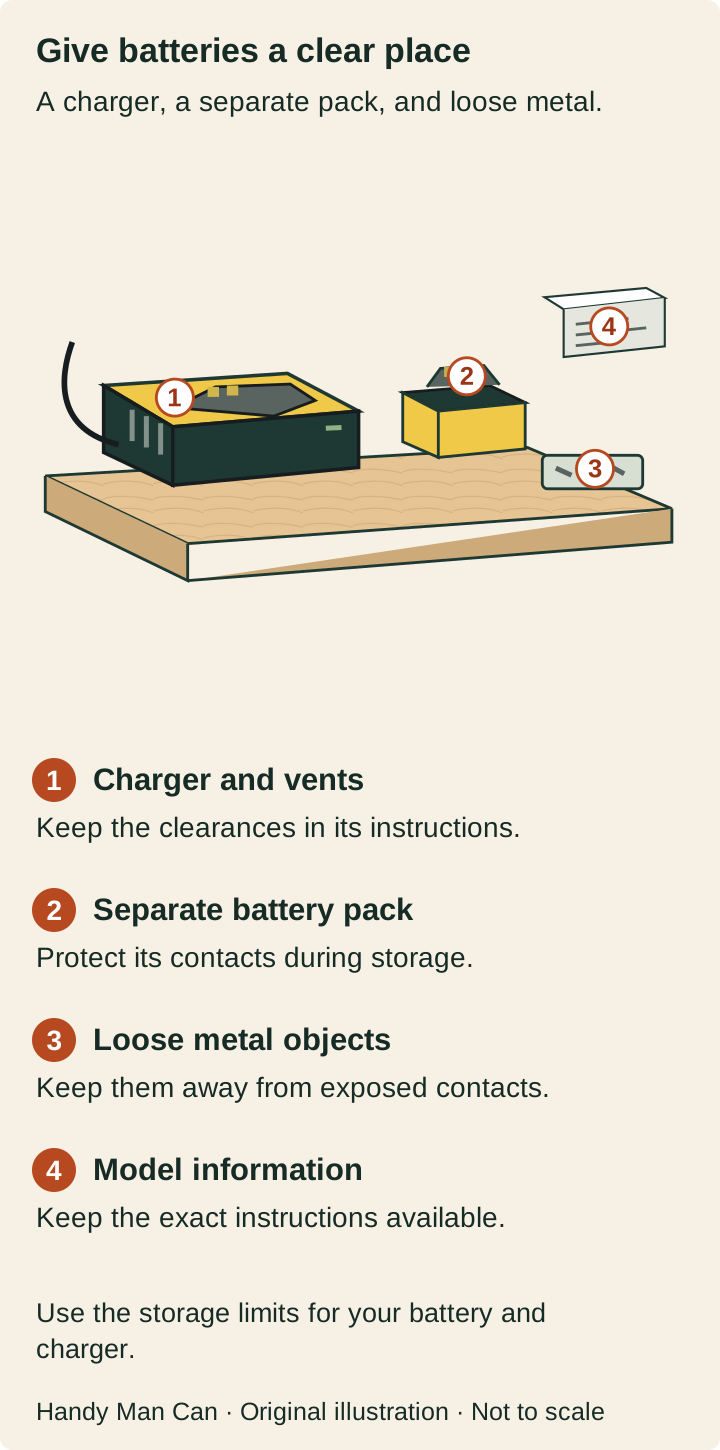
Read the charger’s placement, ventilation, electrical supply, and mounting instructions before you design a shelf. A neat-looking wall station can still be unsuitable if it ignores the exact charger’s requirements.
Make a full-size paper footprint for the charger and mark its instructed clearances and access needs. Place that mock-up where you intend to work so you can see whether a door, drawer, or nearby activity conflicts with it.
Keep the layout simple enough that you can inspect the charger, cord, and pack without moving a stack of supplies. If the only available spot is routinely buried under offcuts, organize a different location before making the station permanent.
Plan the cord route from the approved outlet location to the charger, with no improvised wiring. If the electrical supply or installation is uncertain, have a qualified electrician resolve that part before you use the station.
Label the location with the systems it serves and keep the instructions accessible nearby. Someone borrowing your drill should not have to guess which of several similar-looking chargers belongs to its pack.
Inspect and stop when condition is uncertain
CCOHS’s electric tool guidance includes checking batteries for cracks, leakage, swelling, and terminal condition. It advises removing defective equipment from use and having qualified people handle repairs.
Make inspection a separate step before charging, rather than something you do after connecting the pack. If you observe a problem, stop using or charging it and seek the manufacturer’s specific handling guidance.
Do not open a pack, bypass a protective feature, force a connection, or try an online revival method to find out whether the cells still work. Your practical task is to identify the equipment and communicate the observed condition to the appropriate service contact.
If a battery shows signs of an immediate emergency, move away, keep others away, and contact emergency services. Do not handle an actively failing pack to improve your storage arrangement or take a closer photograph.
Keep loose hardware away from battery contacts
Give removable packs their own instructed storage positions instead of letting them tumble around with screws, bits, keys, or other loose metal. Use the maker’s specified terminal protection where required and keep the identification labels readable.
Include transport in your planning even when the next trip is only across town. Check the manufacturer’s instructions for the exact pack and the carrier’s rules before shipping or flying with it, rather than applying a workshop storage habit to transportation.
When you lend a tool, send the compatible equipment and instructions together. A short checkout note that lists the battery and charger makes it easier to get the same components back and notice an unexplained substitution.
Make the arrangement understandable to another adult
Walk through your storage note as if you had borrowed the kit for the first time. Can you match the pack to its recorded system, find the charger instructions, and see where each component returns without connecting anything to find out?
If the answer depends on a memory such as “the newer black charger,” improve the label while the equipment is still easy to identify. Colors and styling repeat across product generations, while a model identifier gives you something specific to check.
For secondhand equipment, resolve missing identification before you treat the set as ready to use. Ask the manufacturer for help if a worn label or incomplete history leaves a compatibility question unanswered.
Keep the routine short enough to repeat after a normal project: identify, inspect, follow the documented charging or storage procedure, and return the equipment to its assigned place. Add a service note when something changes rather than silently changing the arrangement.
Have an exit route for an unwanted pack
EPA says lithium-ion batteries do not belong in household trash or municipal recycling bins. It directs consumers to suitable battery recyclers, participating takeback services, or local household hazardous waste programs.
For separate used batteries, EPA describes individual bags and nonconductive tape over terminals as handling precautions, and tells you to contact the maker for damaged-battery guidance. Call the receiving program before bringing a damaged pack, because ordinary collection arrangements may not cover it.
Use the CPSC recall and safety warning search with the brand and exact model, then compare the identifiers with any notice. Save a relevant notice and follow its stated remedy; a quick search is not a certification that a product is safe.
Finish your setup with a readable inventory, suitable locations, and the service and disposal contacts you may need. Those small decisions are much more dependable than trying to remember a temperature tip when a hot summer or a winter project changes your usual routine.